Average typing speed by age
The honest answer to "what's a normal typing speed?" is "it depends on who you ask and how they measured." Different studies use different texts, different age cuts, and different selection biases (people who voluntarily test themselves online are faster than the general population). The chart below is the shape of the answer, not a precise reading.
The headline number
For adults overall, the figure most often cited is around 40 words per minute. That's the rough centre of the bell curve across the entire adult population — including people who type rarely, people who hunt-and-peck, and people who never properly learned the home row. Among people who use a computer for work, the average drifts upward to roughly 50 WPM.
By age group
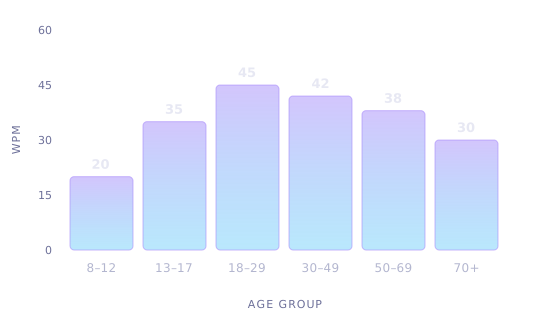
| Age group | Approx. WPM | Context |
|---|---|---|
| 8–12 | ~20 | Still learning. Most kids haven't received formal touch typing instruction. |
| 13–17 | ~35 | Rapid improvement during schooling. Phone-native typists often have weak desktop speed. |
| 18–29 | ~45 | Peak typing demographic — daily computer use, recent formal exposure, gaming and chat practice. |
| 30–49 | ~42 | Slight dip; speed tends to plateau without deliberate practice. |
| 50–69 | ~38 | Slower partly from less daily keyboard time, partly from age-related fine-motor changes. |
| 70+ | ~30 | Significantly more variance; some 70-year-olds still hit 80+ if they've kept practicing. |
Why averages mislead
Three things make population-level typing statistics tricky:
- Self-selection. Most "average WPM" numbers come from online tests, which means people who type the test of their own accord. Slow typists test themselves less. The average is inflated.
- Methodology. A 1-minute prose test, a 5-minute prose test, a code-typing test, and a free-form-writing test will all give different numbers for the same typist. Most cited averages are 1-minute prose tests.
- Variance. Within any age group, the spread is enormous. The 18–29 group's "average" of 45 contains plenty of 25-WPM typists and plenty of 80-WPM typists. A point estimate doesn't tell you which side of the bell curve you're on.
By typing method
Method matters more than age:
| Method | Typical WPM |
|---|---|
| Hunt and peck (2 fingers) | 20–30 |
| Hybrid (some touch typing) | 30–45 |
| Trained touch typist | 50–70 |
| Professional typist / transcriptionist | 70–90 |
| Top 1% of online testers | 100+ |
| World record (English prose) | ~200 |
The single biggest jump for most people comes from actually learning touch typing. Anyone who can already type 30 WPM hunt-and-peck can usually reach 50–60 WPM with a few weeks of structured practice — not because they've gotten smarter, but because their fingers are no longer searching.
What "good enough" actually means
Speed only matters relative to what you're doing. Rough thresholds:
- 40 WPM — you can keep up with messaging and short emails without the keyboard slowing you down.
- 60 WPM — you can write long-form prose at the speed you think. This is the speed at which most professional writers report being "comfortable."
- 80 WPM — diminishing returns kick in. Going faster doesn't make you write better.
- 100+ WPM — useful for transcription, court reporting, very fast typing competitions. Not useful for almost any normal job.
If you're a knowledge worker, the goal isn't "as fast as possible." It's "fast enough that you stop noticing the keyboard." For most people that's somewhere in the 50–70 range.
How to find your own number
The most honest test:
- Pick prose you didn't write — a news paragraph, a book excerpt, anything you have to read as you type.
- Type it for at least 60 seconds. Shorter tests are too sensitive to a lucky or unlucky burst.
- Count only the characters you typed correctly — divide by 5, then by minutes. That's your accuracy-adjusted WPM.
- Run it three times. Take the median, not the best. Your "best" run is a flattering outlier.
typer includes a built-in 60-second test mode (the "60s" button) that does this automatically — fixed text, smoothed average across the run, and a personal-best tracker so you can see your trend over weeks. The full app uses the same accuracy-adjusted formula on every lesson.
How to actually improve
The fastest way to bump your WPM in a few weeks:
- Learn the home row. If you're still hunt-and-pecking, this is the only thing that matters until it's fixed. Don't skip ahead to "speed tips" before this is automatic.
- Practice deliberately, not just often. 15 minutes of focused practice beats two hours of casually typing emails. Use a tool that gives feedback on accuracy.
- Slow down before you speed up. Most plateaus are accuracy plateaus — you're guessing where keys are. Drop your speed for a week, aim for 99% accuracy, then let the speed come back.
- Target your weaknesses. Most people are slow on specific bigrams (two-letter pairs like
nt,er,th) or specific keys. Tools that highlight your slowest letters compress months of practice into weeks.
One concrete plan: if you're below 40 WPM, focus on touch typing fundamentals for 2–3 weeks before chasing speed. If you're 40–60 and plateaued, the issue is almost certainly accuracy on specific keys. If you're 60+, you're already past the "useful" threshold — only chase higher numbers if you enjoy the chase.